(SPRING, 2013)
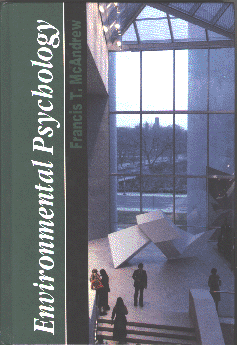
Multiple Outside Readings (OR) are on Reserve in the SMC Library
CONTACT INFORMATION:
Frank McAndrew, E-131 SMC, Ext. 7525
e-mail: fmcandre@knox.edu.
Psychology Department Web Page
Environmental Psychology On-Line Resources
Careers in Environmental Psychology
Project #1 is a group project that will be worth 10% of your grade. In this group project, your group will compile a photographic portfolio of something called “Physical Traces of Behavior,” and one or more of your group’s members will make an oral presentation of your findings. Project #2 is a project that will help you examine the relationship between the dynamics of your family life and the architecture of your home. Many of the psychological needs for privacy, personal space, and territoriality that we will be discussing this term are mediated by the architecture of a family’s living space, and I am hoping that your experience in this course will make you a more critical and sophisticated observer of your home environment as well as other built environments. This project will result in a thoughtfully written 7 to 10 page paper.
GRADING
SCALE:
93% - 100% = A
90% - 92% = A-
88% - 89% = B+
83% - 87% = B
80% - 82% = B-
78% - 79% = C+
73% - 77% = C
70% - 72% = C-
68% - 69% = D+
63% - 67% = D
60% - 62% = D-
<60% = F
LEARNING GOALS:
The psychology department learning goals assessed in this course include the following:History & Methods of Research (Chapter 1; pp. 98-103; OR #1)
Environmental Cognition (Chapter 3, OR #2)
The Natural Environment (Chapter 2; pp. 456-463; OR #3, 4, 5, 6)
Environmental Problems/Behavioral Solutions (Chapter 14; OR #7, 8, 9)
CLASS PROJECT #1 (10%): Photographing Physical Traces - Due Date: Thursday, April 18th
TEST #1 (25%) - Approximate Date, Tuesday, April 23rd
The Ambient Environment & Personality (Chapters 5 & 6; pp. 103-113; OR #10, 11)
Environmental Stress (Chapter 7; pp. 116-124; OR#12)
Personal Space, Privacy, & Territoriality (Chapter 8; OR #13, 14, 15)
Crowding (Chapter 9; pp. 113-116, 124-131; OR #16)
TEST #2 (25%) - Approximate Date, Tuesday, May 13th
Architecture & Behavior I: Engineering for Human Behavior (Chapter 11; OR #17, 18)
Architecture & Behavior II: Residential Environments (Chapter 12, OR #19, 20, 21)
CLASS PROJECT #2: Architecture and Family Life Style - Due Date: Thursday, May 23rd
Architecture & Behavior III: The City (Chapter 10; OR # 22, 23)
Architecture & Behavior IV: Work & Learning Environments (Chapter 13; OR #24)
TEST #3 - During Scheduled Final Exam Time
OUTSIDE READINGS ON RESERVE IN THE SMC LIBRARY
1. Memories of Childhood Homes: Some Contributions of Environmental Autobiography to Interior Design Education and Research.(Boschetti, 1987)
2. Sex Differences in Spatial Abilities: Evolutionary Theory and Data. (Silverman & Eals, 1992)
3. A Womb with a View.(Hester, 1979)
4. The Curse of Abel.(Crownfield, 1973)
5. The New Ecological Paradigm (NEP) Scale (Anderson, 2012)
6. The Japanese Garden(Eliovson, 1978)
7. Instructions as a Determinant of Paper Disposal Behaviors.(Geller, Witmer, & Orebaugh, 1976)
8. The mural as graffite deterrence. (Craw, Leland, Bussell, Munday, & Walsh, 2006)
9. Standing for where you sit: An exploratory analysis of the relationship between academic major and environment beliefs. (Ewert & Baker, 2001)
10. Deviance in the Dark.(Gergen, Gergen, & Barton, 1973)
11. The Effects of Musical Style on Customers' Spending (North, Shilcock, & Hargreaves, 2003)
12. Human Perfoermance in Polar Enviornments (Leon, Sandal, & Larsen, 2011)
13. How to Spot a Scoundrel (Herbert, 2012)
14. A
Fine heritage of feuding (Kroll, 2004)
15. Territorial Markings as a Predictor of Driver Aggression and Road Rage (Szlemko, et al, 2008)
16. Population Density and Social Pathology(Calhoun, 1962)
17. Feng Shui and Environmental Psychology: A Critical Comparison (Bonaiuto, Bilotta, & Stolfa, 2010).
18. Fear of Crime in Relation to Three Exterior Site Features: Prospect, Refuge, and Escape.(Fisher & Nasar, 1992).
19. Architecture, Interaction, and Social Control: The Case of a Large Scale Public Housing Project.(Yancey, 1971).20. Residential Territories: Cues to Burglary Vulnerability.(Brown, 1985)
21. Push
and pull forces away from front
porch use. (Wilson-Doenges, 2001)
To see copies of the powerpoint slides that were used in the lectures for this course, click on the picture of the overhead projector.