Psychology 369 - EVOLUTION & HUMAN
BEHAVIOR - Winter, 2020
Tuesday/Thursday, Period 5s, Room A-205 SMC
TEXTS:
Evolutionary
Psychology: The New Science of the Mind (6th., David Buss, 2019)
ISBN: 978-1-138-08861-0
How
Humans Evolved (8th Ed. Boyd & Silk, 2018) ISBN:
978-0-393-60345-3
Multiple
Outside Readings (OR) listed below are downloadable from this web page.
CONTACT
INFORMATION:
Frank
McAndrew, E-131 SMC, Ext. 7525
e-mail: fmcandre@knox.edu.
Psychology
Department Web Page
TIPS
FOR DOING WELL IN THIS COURSE (or any course!)
Psychology
Department Writing Policy
Evolution
and
Human Behavior: An Introduction to the Course
This
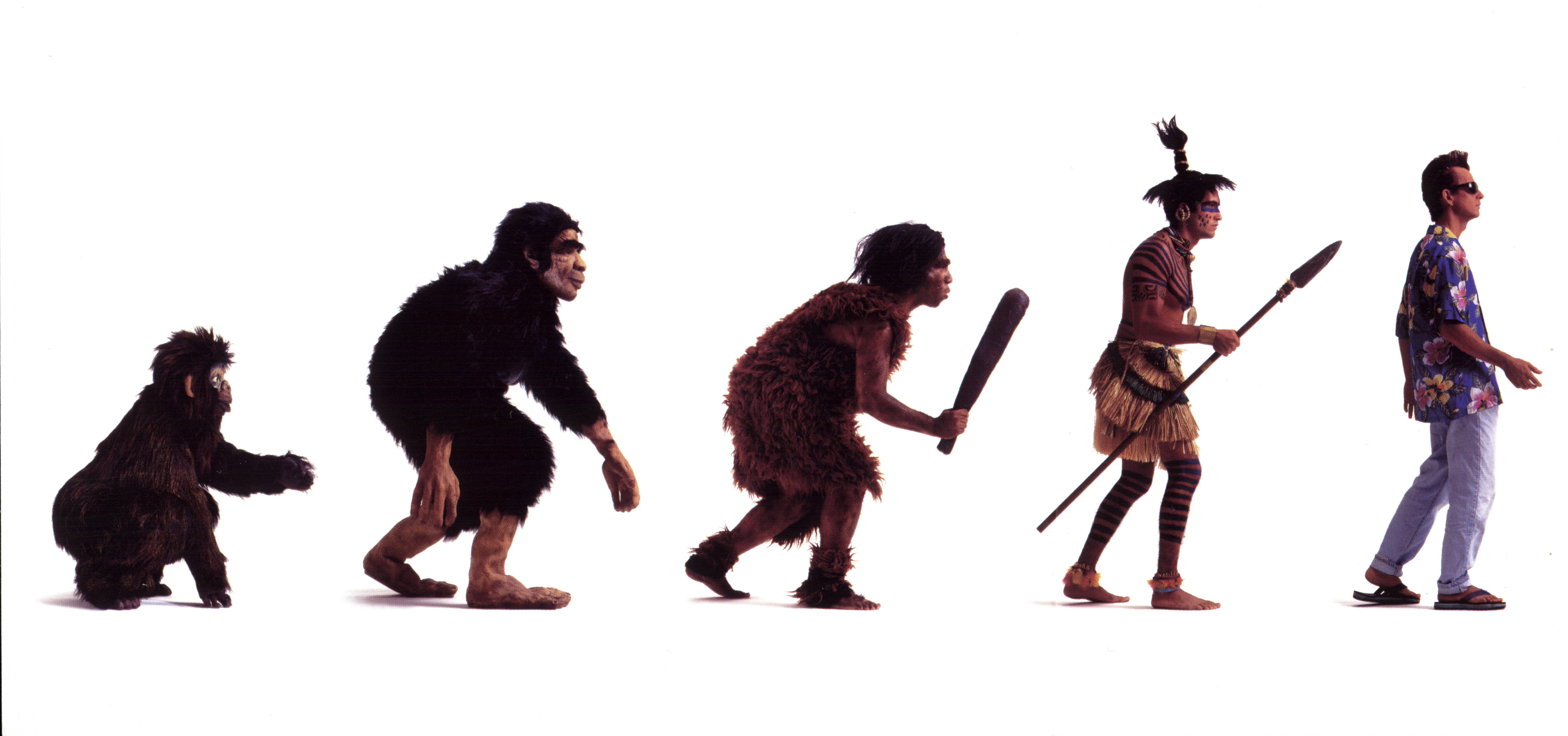
course will be about "Human Nature." The primary assumption of
the course is that the human “mind” and Human behavior have been shaped
by the process of natural selection in our evolutionary past.
Thus, we will be making some different assumptions about human nature
than you may have encountered in most of the other courses in the
social sciences that you have taken at Knox. We will explicitly
be taking the position that people do NOT come into the world as blank
slates waiting to be shaped by their environment and experiences, but
rather that we are born with a relatively well-developed arsenal of
strategies, preferences, and passions that enabled our ancestors to
survive in our ancestral environments. This is not to say
that experience and environment are unimportant, but only that we come
into the world more prepared to deal with some types of experiences and
environments than others. This field has been a strong research
interest of mine for quite some time, and I hope that this course
entices you to want to learn more about it as well. Click on the link
to find out more about my research
interests in evolutionary psychology
and to see links to other evolutionary psychology web sites. Also
follow the links to get more background
on human evolution and to see a Timeline
of Human
Evolution. For some fun and interesting books to
read to ease you into this topic, I recommend the following: The
Murderer Next Door, How
the Mind Works, The
Rational Animal, & Mother
Nature.
GOALS OF
THE COURSE
As an advanced 300 level course in
psychology, Evolution & Human
Behavior will expect you to work at a
very advanced level relative to courses that you may have taken with me
before. This means that there will be a LOT of reading, and much
of the reading will be from primary sources (i.e., journal
articles). You will also be given the opportunity to integrate,
practice, and display the research skills you have been working on in
smaller chunks in earlier courses. Every course that you
take is designed to help you acquire knowledge and skills. This
course will help you achieve the following departmental learning goals:
1) Apply the scientific method to studying the mind, the brain, and
behavior.
2) Successfully search the scientific psychological literature to find
existing work that can inform the
specific claims they are making.
3) Understand the basic theoretical approaches and classic empirical
findings of psychology.
4) Select and conduct appropriate statistical tests in order to
empirically test a claim.
5) Effectively communicate with clear, grammatically-correct writing
that conforms to APA style.
6) Make effective oral presentations that are clear, well-organized,
and interesting.
The group project addresses ALL of the goals listed above. The
textbook, outside readings and lectures address goals #1 & #3; the
exams, discussions, and quizzes assess how well you have achieved these
two learning
goals.
REQUIREMENTS
In this
course, you will take a mid-term
exam, a final exam, complete a group research project, and take several
short quizzes on and engage in a discussion of several of the outside
readings you will be
doing in the course. Each test will be an essay
test, and
each test will be worth 30% of your final grade.
The Group
research project will be worth 25% of your final grade, and the
quizzes/discussions (collectively) will also be worth 15% of your final
grade.
GRADING
SCALE:
93% - 100% = A
90% - 92% = A-
88% - 89% = B+
83% - 87% = B
80% - 82% = B-
78% - 79% = C+
73% - 77% = C
70% - 72% = C-
68% - 69% = D+
63% - 67% = D
60% - 62% = D-
<60% = F
THE GROUP RESEARCH PROJECT:
In
this course, you will be assigned to a research team that will complete
an evolutionary psychology study from start to finish. The
research problem will be assigned to you with more details in class,
and the problems will be different from year to year. Your
team
will be responsible for the following aspects of the project:
- Going
through
the process to gain approval from the Institutional Research Board
- Finding
relevant literature and
writing a literature review
- Generating
plausible hypotheses based upon the literature you have found
- Collecting
data
- Analyzing
& displaying data with appropriate statistical tests and
procedures
- Writing
a scientific paper in proper
APA format
- Preparing
a professional quality
poster
- Making
an
oral presentation of your project to the class and to the departmental
faculy
- If
the project is of sufficient quality, one of you will
present it at the annual ILLOWA Psychology Conference to be held at
Knox in April.
Please note that the Psychology
Department Writing Policy will be enforced in the grading of the
research papers resulting from the group project.
Some
thoughts on group work:
You will be assigned to research teams, and you will not have any input
in choosing your colleagues. In real life work and research
teams, you do not get to choose to work with your friends, but rather
you have to work with the people you end up with; this will also be
true this term. Everyone in your group will get exactly the
same
grade on the assignment even though you will undoubtedly find that
there is a range of talent and motivation among the team members just
as there is in any other work group. While this is very much
a
team effort, many of you may perceive unfairness in that it is
inevitable that some of you will think that you have worked a lot
harder than some of your colleagues or that your efforts were of higher
quality. This is an issue for you to work out for
yourselves. Discover what the strengths and weaknesses of
your
colleagues are and divide the labor in a way that plays to an
individual’s strengths. By pooling your efforts
efficiently, you should end up with a project of higher quality than
any one of you could have produced by yourself within the confines of a
term. My primary concern is with the quality of the finished product,
just as it would be if you were a group doing a study in a laboratory
sponsored by my grant or if you were a work group reporting to me in a
corporation or a government agency. Working in teams is the
way
things get done in the real world of work, and I hope that this
experience prepares you in at least a small way for your professional
life after Knox.
UNITS
& READING ASSIGNMENTS
[Major Sub-topics
are Listed in Brackets
Under Each Unit Heading]
Tuesday, January 7: Introduction
to Evolutionary Psychology
[The EEA (Environment of Evolutionary Adaptedness) - Buss, Chap.
1; Boyd & Silk, pp. 387-391]
[Ethology & the link between evolution & behavior]
[Evolutionary Psych vs. the SSSM]
Thursday, January 9: Basic
Principles of Evolution
[Adaptation by Natural Selection - Buss, Chaps. 3 &
pp. 32-43, 52-63]
[Sexual Selection - Boyd & Silk, Chap. 1 & pp. 155-163]
[Speciation - Boyd & Silk, pp. 81-93]
Tuesday, January 14: Primate
Ecology & Behavior
[Primate Ecology
& Behavior - Boyd & Silk, Chaps. 5
& 6]
Thursday, January 16: Human Evolution & Prehistory
[Bipedalism &
History of the Human Lineage - Boyd & Silk, Chaps. 10, 11, 12,
13] [OR #1 & 2]
Tuesday, January 21:
Evolution of the Human Mind
[Evolution
of
Emotion - QUIZ/DISCUSSION - OR#3 & 4]
[The Modular Mind: Evolved Psychological Mechanisms and Domain-Specific
Cognition - Buss, pp. 43-51; 372-375]
[The Development of Cognition in Children: The Importance of a
“Theory of Mind" - Buss, pp. 380-381]
Thursday, January 23: Evolution
&
Language
[Why Did Language Evolve? Language as an Adaptation -
Buss, pp. 370-373]
[Patterns of Language Development in Children]
Tuesday, January 28: QUIZ:
[Sex Differences in Cognition - QUIZ/DISCUSSION OR
#5, 6, & 7]
Thursday, January 30 : CATCH-UP
DAY
Tuesday February 4: MID-TERM EXAM
Thursday, February 6: Evolution
& Human
Development: Children, Parents, & Families
[Life History Theory - Boyd & Silk, Chap. 8]
[Human Development Across the Life Span]
[Attachment Theory - Buss, pp. 381-383]
[Sex Differences in Development - OR #8]
Tuesday, February 11: Evolution
& Human
Development (cont'd)
[Parental Investment - Buss, Chap. 7;
OR #9]
[Sibling Relationships & Birth Order - OR #10 & 11]
[Parent-Offspring Conflict]
[The Trivers-Willard Effect]
Thursday, February 13: Human
Mate Choice
[Buss, Chaps. 4, 5, 6]
[Short-term vs. Long-term Mating Strategies - Boyd & Silk, pp.
395-404 OR #12]
Tuesday, February 18: Human Mating Strategies (cont'd)
QUIZ/DISCUSSION
OR #13, 15, 18
Buss, Chap 11
[The Aesthetics of Sexual Attractiveness - OR #13 & 14]
[Human Pheromones - OR #15, 16, & 17]
[Inbreeding Avoidance - Boyd & Silk, pp. 391-394]
[Jealousy, Mate Guarding, & Sexual Violence - OR #18 & 19]
Thursday, February 20: Inclusive
Fitness &
Kin Selection
[Hamilton's Rule - Boyd & Silk, Chap. 7;
Buss, Chap. 8]
Monday,
February 24
DEADLINE FOR COLLECTION OF DATA BY GROUPS
Tuesday, February 25: Altruism, Cooperation, & Morality
[Buss, Chap. 9 & pp.
383-388]
[OR #20, 21,
&
22]
Thursday, February 27: The Science of Sex Appeal (Video)
Tuesday, March 3: Aggression
[Aggression - Buss, Chap. 10]
[OR #23, 24, & 25]
Thursday, March 5: CATCH-UP DAY &
QUIZ/DISCUSSION OR #24 & 25
Tuesday March 10: ORAL PRESENTATIONS;
FINAL
DRAFT OF GROUP SCIENTIFIC PAPERS ARE DUE; POSTERS
PRESENTATIONS BY RESEARCH TEAMS
FINAL
EXAM: At scheduled time
during the Final Exam Period
DOWNLOADABLE OUTSIDE READINGS
2. New Neanderthal demise date
and Neanderthal genes in modern human DNA (Bower, 2014)
3.
My
baby doesn't smell as bad
as yours: The plasticity of disgust
(Case,
Repacholi, & Stevenson, 2006)
4. Don't
go there: The evolution
of disgust (Curtis, 2013)
5. Preschool
Children
Recognize the Utility
of Differently Shaped Trees: A Cross-Cultural Evaluation of Aesthetics
and Risk Perception. (Coss & Moore, 1994)
6. Sex
Differences in
Spatial
Abilities:
Evolutionary Theory and Data. (Silverman & Eals,
1992)
7. Threat is in
the sex of the
beholder: Men find weapons faster than do women (Sulikowski,
2014)
8. Sex
Differences in
response
to Children's
Toys in Nonhuman Primates (Alexander & Hines, 2002)
9. Sex Differences
in Visual
Attention Toward Infant Faces (Cardenas, Harris, & Becker, 2013)
10. Differential
Parental
Investement in
Families with Both Adopted and Natural Children (Gibson, 2009)
11. Playing Favorites
(Kluger,
2011)
12. A
reexamination of sex
differences in sexuality: New studies reveal old truths. (Schmitt,
et
al, 2012)
13. The Pupils are the
Windows to Sexuality: Pupil
Dilation as a Visual Cue to Others' Sexual Interest (Lick,
Cortland,
& Johnson, 2016)
14. The sound of female shape: A
redundant signal of
vocal and facial
attractiveness (Abend, et al, 2015)
15.
Fertile and
selectively flirty: Women's
behavior toward men changes
across the ovulatory cycle (Cantu,
et al, 2014)
16. Scent
of a Woman: Men's
Testosterone
Responses to Olfactory Ovulation Cues (Miller & Maner, 2010)
18. Competitive
reputation manipulation: Women strategically transmit social
information about romantic rivals
(Reynolds, Baumeister, & Maner,
2018)
19. Male
Sexual
Proprietariness and Violence
Against Wives (Wilson & Daly, 1996)
20. "Women and
Children First"
Holds Only if
a Ship is Sinking Slowly (Sanders, 2010)
21. New
Evolutionary Perspectives on
Altruism: Multilevel-Selection and Costly-Signaling Theories.
(McAndrew, 2002)
22. Historical and
experimental evidence of sexual
selection for war heroism (Rusch, et al, 2015)
23. Human
Evolution and Human
History: A
Complete Theory (Bingham, 2000)
24. Foundations
of the Crazy
Bastard Hypothesis: Nonviolent physical risk taking enhances
conceptualized formidability (Fessler, Tiokhin, Holbrook,
Gervais, & Snyder, (2014)
25. Human Perception
of Fighting Ability: Facial Cues
Predict Winners and Losers in Mixed Martial Arts Fights (Little,
Trebicky, Havlicek, Roberts, & Kleisner, 2015)
To see the powerpoint slides for
this course, click on the picture of
the gorilla below