Physics 110
Prelab 9
Introduction
{Refer to sections 10.5 to 10.7 and 12.2 to 12.3 in Giancoli
for this lab.}
Rotational
equilibrium.
A net torque acts to cause an angular
acceleration (changing rate of rotation) about some axis of rotation. The
magnitude of a torque is given by

where R is the radial distance from the axis of rotation
to the point of the force’s application, F is the magnitude of the
force and  is the angle between the two. It
should be clear that the maximum torque will occur when a given force F
is applied perpendicularly to the radial arm R (i.e.
tangentially).
is the angle between the two. It
should be clear that the maximum torque will occur when a given force F
is applied perpendicularly to the radial arm R (i.e.
tangentially).
This explains why it’s easier to open a door when you push farther from
the side with the hinges: for the same applied force you get a larger torque.
Just as many forces can act on an object at rest yielding a net force is zero
and thus no translation, so may many torques act on an
object at rest yielding a net torque of zero and no rotation.
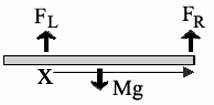
Consider the rod above of length L being supported
horizontally by two strings, one at its right end and one a distance x
from the right end. Including gravity, there will be three forces on the
rod. Note that the force of gravity can be thought of as acting at the center
of the rod. These forces will also create torques on the rod which will
try to rotate it.
Torque is a vector, it has magnitude and direction.
If a torque tries to induce a clockwise rotation about a given axis, the
direction of that torque is away from you (we’ll call it negative).
The torque is pointed toward you and will be positive if it tries to induce a
counterclockwise rotation. For a body to be in equilibrium the sum of the
forces must be zero and the sum of the positive and negative torques
must also be zero.
In the first experiment this week you will determine what
forces FL and FR must be applied so that a
suspended rod is in equilibrium.
PL1. Explain why we should see FL + FR
= Mg, where M is the mass of the suspended rod.
PL2. In a static equilibrium problem, it is possible
to choose any axis of rotation that you would like. When calculating the torques on an
object, it is often convenient to choose an axis of rotation at the location of
one of the applied forces so that no torque will result from that force. Choose the right end of the rod as the
axis of rotation. Calculate the sum
of the torques with the right end of the rod as the axis of rotation. If x
is the distance from the right end to FL and L is the
length of the rod, show that FL = (MgL/2x).
PL3. Suppose the length of
the rod is 1 meter and its mass is 1 kg. Using the midpoint of the rod as your axis of rotation, determine
the force FR at the right
end of the rod and the force FL at x = 0.75 meters required for
static equilibrium.